
Calling that starts from the objective, not a script. Nothing runs until a person signs it off.
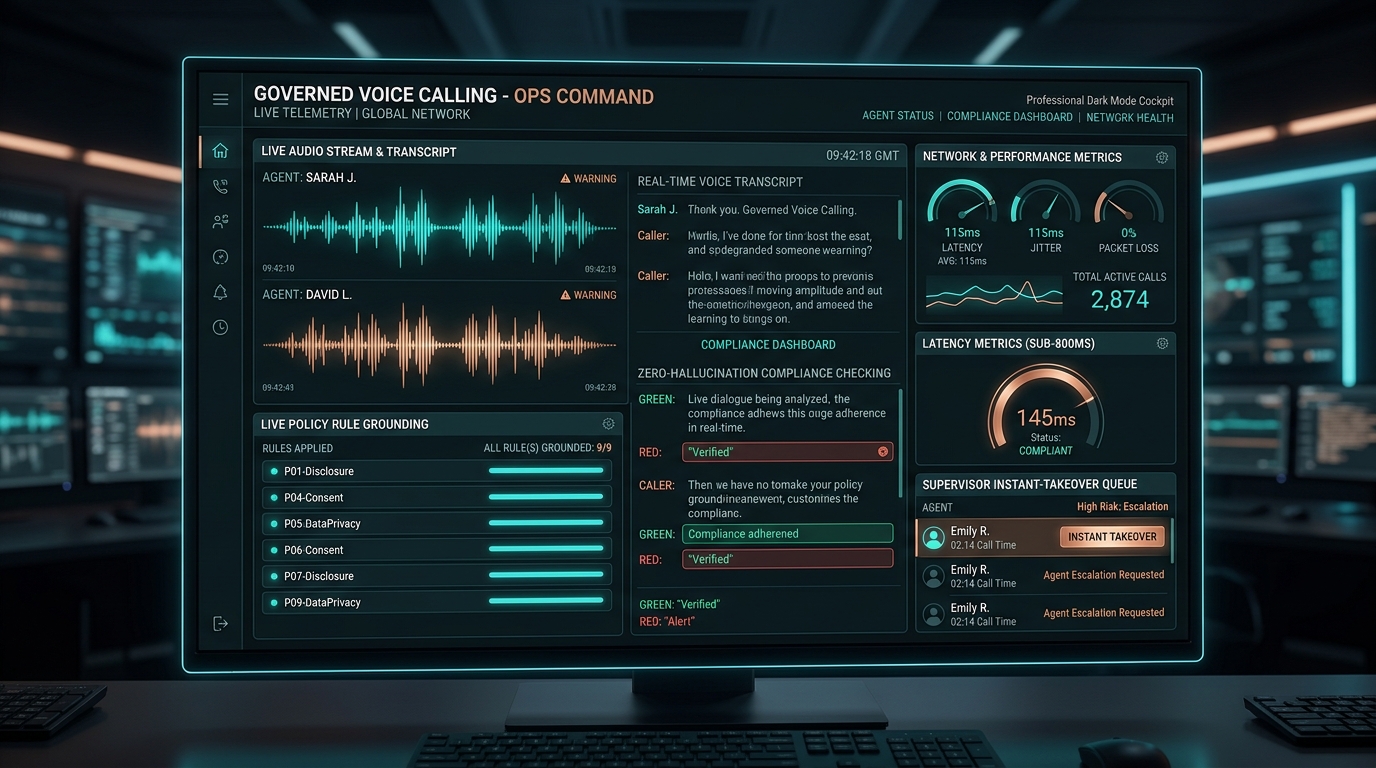
Built from your vocabulary. Approved by your people. An observer rates every call as it happens. A supervisor sees the reds and can take over, mid-call.
What the system will and will not do
Answers from approved material. Does not improvise.
It answers product questions from approved material. Where a customer asks something outside it, the agent says so and arranges follow-up. It does not improvise.
Not a persuasion system.
No objection handling, no conversion optimisation, no pressure. A call that clarifies is doing its job; a call that convinces someone against their interest is a failure of the design, not a feature of it.
The customer-claim boundary
What a customer says on a call becomes a record of what that customer said - attributed to them, timestamped, with the recording as its source. It never becomes our conclusion about anyone.
If a customer says they were told something that was not true, the system records that the customer said it. It does not determine whether they were mis-sold, and it does not name an employee or an agent. That determination belongs to your risk and audit functions, through your own process, and the record is routed there for them to weigh.
Where several customers independently raise comparable concerns about the same product or channel, that becomes visible - as a pattern about the product or the channel, never about a person.
Outcomes flow into your existing systems
Outcomes flow into your CRM, case management or ticketing systems. Calling is an operation, not a silo - the record of the call and its outcome belongs in the systems your teams already work in.
Inbound Service
Policy-grounded resolution for routine customer service with warm human handoff.
Outbound Calling
Objective-first outbound outreach for collections, reminders, and confirmations.
Live Supervision
Every call rated live (green / amber / red). Supervisor sees the reds and can take over mid-call.
Deploy governed voice calling in shadow mode
Launch a controlled pilot on one bounded inbound or outbound flow.