
In most businesses, lost knowledge is friction. In a law firm, it is inventory.
A matter changed hands, and the reasoning behind its position did not survive.
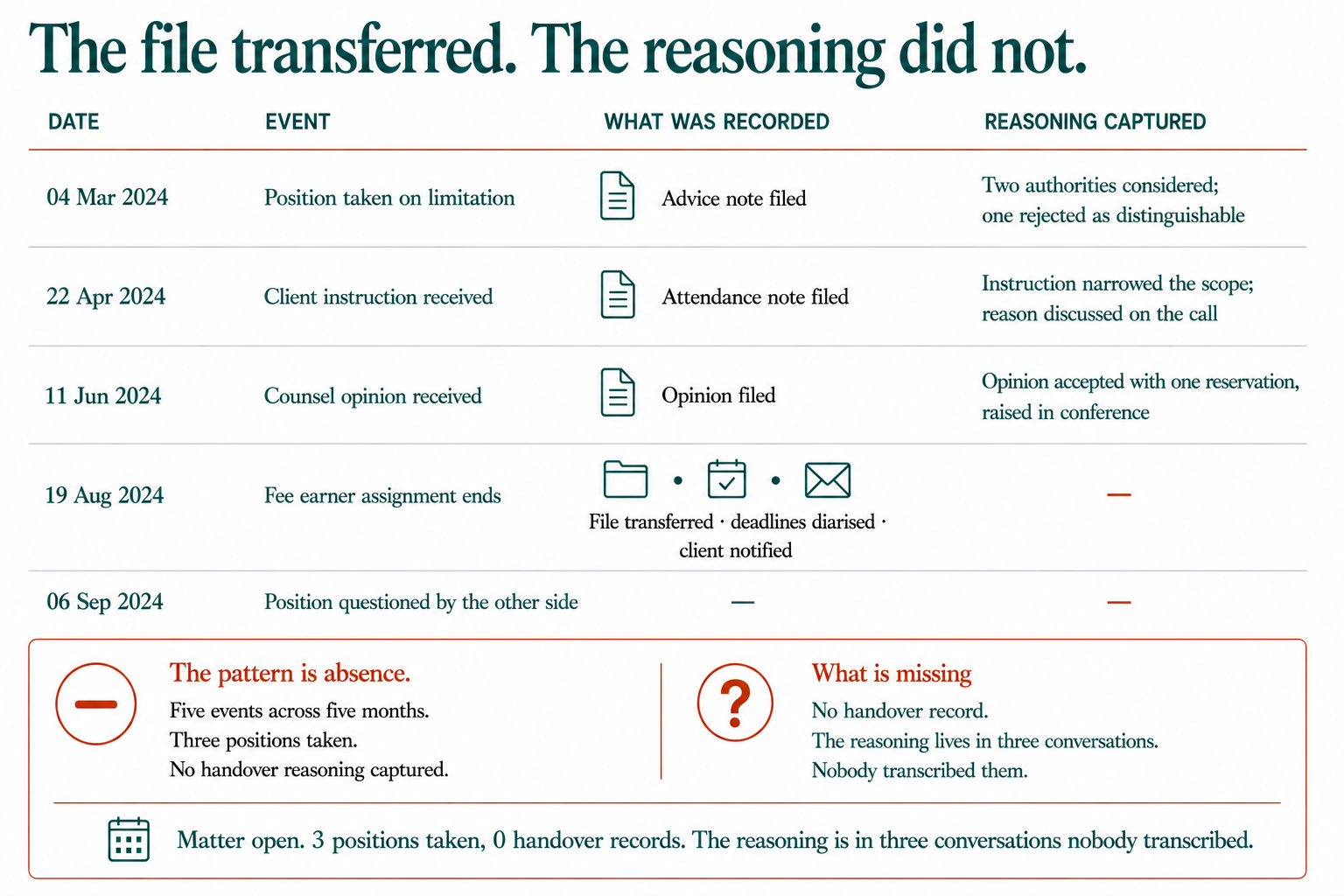
The file transferred. Why the position was taken did not.
Why nobody catches this today
An associate leaves a live matter in March. The file goes to a colleague, the client is told, the deadlines are diarised.
What does not transfer is why the firm took the position it took - the case that persuaded them, the argument they considered and rejected, the client instruction that shaped it. That was a conversation.
Six months later somebody has to reconstruct it, and the only evidence is the position itself.
What else dhi looks for
An undertaking given on a call, never diarised, never discharged. Elsewhere a dropped commitment is an inefficiency. In a firm it is a conduct matter.
Substantive work on a matter with no completed conflict check on file. See the boundary below - this is a process observation, not a conflict finding.
A matter dormant for six months and never formally closed. Retention, conflicts and former-client duties attach to closure, not to inactivity.
Privilege classification trending to contested without resolution. A finding about the firm's own classification, touching no privileged material.
What dhi will not do here
dhi does not perform conflict clearance. It records that a conflict concern was raised. It does not check, clear, or decide.
A conflict-check finding says: no completed check is on file. It never says: this matter may conflict with that one. The first is a fact about your own file; the second would make dhi a clearance engine whatever the documentation said.
And ethical walls are not something dhi detects. They are enforced by the access model - deny overrides allow, always, and a wall survives a reorganisation.
Domain model and pattern library complete.
Deploy dhi in your practice management workflows
Run a shadow mode pilot on matter transitions and committee minutes.